If we have already scheduled appointments via WhatsApp, ordered groceries at the supermarket and made bank transactions via the app, Why not order an Uber there too? The question, from WhatsApp's head of Latin America, Guilherme Horn, underpins and explains the app's newest venture. Yes, Ordering Uber via WhatsApp is now possible! Understand how this new modality works and what's behind it in terms of strategies and market trends to follow.
How does it work?
Here's the bad news: for now, the service is in test mode only in the following Brazilian cities: Teresina (PI), São Luís (MA), Sobral (CE) and Juazeiro do Norte (CE). The expectation is that it will soon be consolidated in all municipalities in Brazil.
Brazil is the second country in the world (already operating in India) to receive the new feature. The app's dominance here explains its preference and pioneering role in introducing the feature in Brazil – both WhatsApp and Uber are already established technologies in the country, with their use more than approved by their users.
How to order?
For now, the function is available only for UberX and Uber Moto categories. Races need to be paid in cash and the service only works between 6am and 10pmThese limitations tend to be relaxed as the service is implemented and naturalized here.
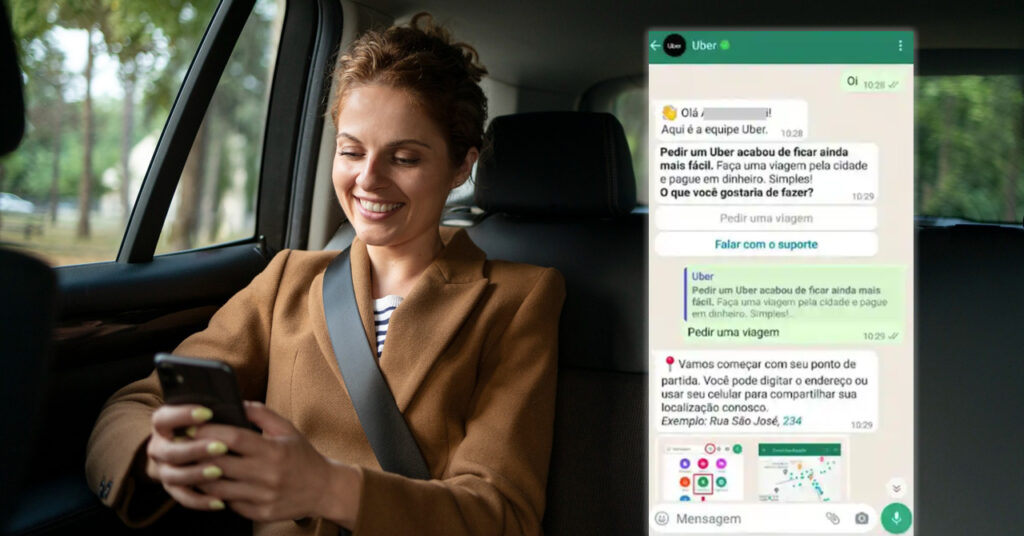
When requesting an Uber on a cell phone, the user (with an Uber account registered and already logged in to the app) directly opens WhatsApp, confirming details of the origin and destination of the trip through messages forwarded to the number (11) 94488-3478.
According to Uber, safety features remain the same: GPS trip logs and driver-partner checks.
Market trend
Here is a pertinent question: Why would users stop using Uber's own app in favor of using it via WhatsApp? What do they have to gain?
Some specific scenarios help answer these questions. Users find it less easy to handle different apps would adopt the solution, given that the messaging application is much more consolidated in the Brazilian scenario, with wide acceptance and natural use by people.
Users also with little storage space on cell phones would see the news with good eyes.
More than that, from a business point of view, Uber and WhatsApp are reportedly expanding access to their services and acquiring new users.
WhatsApp in turn confirms the strong trend in integrate services into your platform, either directly to the user, such as WhatsApp Pay; or through companies who increasingly use the application as an important sales, service and support channel.
THE WhatsApp Business API (service also offered by Brazilian Matrix, official partner of Meta) – business modality of the application – is an example of how a multitude of different services can be explored via WhatsApp: transactional messages, appointment and event reminders, product tracking, sending invoices and documents, digital contract signatures, satisfaction surveys, among others.
If there is something we will see in the next few years (and we better get used to it) it will be this integration of platforms, applications and software, strengthening brands, diversifying services and above all, guaranteeing users an increasing choice!
READ ALSO: “Tips to protect your WhatsApp!”
READ ALSO: “How to get the WhatsApp green badge?”