

If there is an area that fundamentally Artificial Intelligence can make a difference, this area is the Medicine. When what is at stake is people's lives and health, it is crucial count assertiveness, consistency and speed – characteristics inherent to this technology. Given the sensitivity of the area, some view technological adoption with some trepidation, but much of essence of AI is already in operation, if not in testing for application. A natural path that tends to benefit patients, doctors and society as a whole. We then list some of the main applications of AI in Medicine. Follow along below.
Telemedicine
One of the clearest and most evident uses of technology, especially Artificial Intelligence. Remote medicine or telemedicine is a form of consultation with a virtual doctor via phone call or video conference.
Its use was widespread during the pandemic, when restricted contact and distancing became paramount.
Such technology helps in disease monitoring, patient filtering and selection, and general consultations, especially in remote regions and/or with little or no medical care. In a country of continental proportions like Brazil, telemedicine democratizes medical access!
And today, in addition to having doctors and health professionals on the other line, also operates with Chatbots trained for pre-service.
Research and Public Health
The high capacity of the IA in read and manage a large volume of data proves to be efficient in analysis and identification of patterns and symptoms which consequently contribute to medical research and public health data.
The Coronavirus pandemic, for example, involved the merging, organization, and management of data from different global public health databases to measure the speed of the virus's infection, as well as the immunization process – fundamental issues for controlling and mitigating the disease.
Professional Medical Support
Making quick and assertive decisions is one of the key factors in medicine; and aiming to reduce medical errors or decisions made in an untimely, influenced and/or biased manner, Artificial Intelligence is put to the test. A pilot project at Stanford University, for example, uses algorithms to categorize patients high-risk patients who require intensive care in the ICU.
This probability assessment is already widely used in the most modern health units in favor of a isonomic filtering of patients that arrive.
More than that, a study by the University of Florida in partnership with NVIDIA managed to find that AI interprets and develops accurate medical notes, so similar to human work that it has even confused professionals in the field. Generative AI (along the lines of Chat GPT) applied to healthcare offers even greater potential for medical support.
Surgeries
THE IA may not yet eliminate the need for surgery and more invasive procedures as commonly seen in science fiction films. But potentially reduces the time of these operations and their degree of assertiveness.
Surgical robots are increasingly common in large hospitals and medical centers, assisting surgeons or even being operated on by them. Many provide operations with smaller incisions, less prone to errors and with superior results.
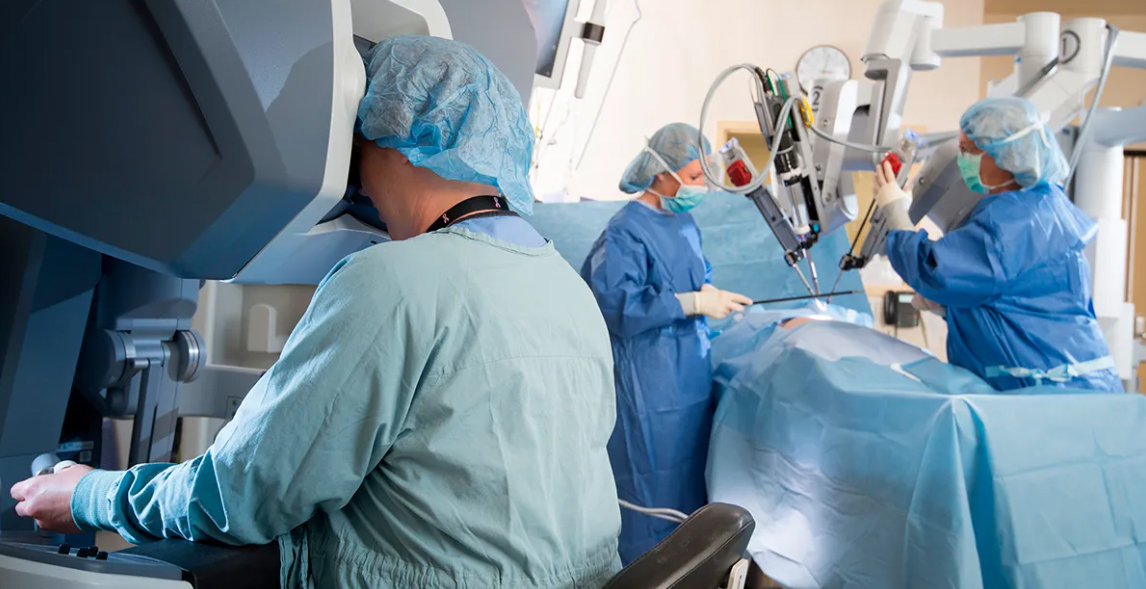
Mechanized labor also removes a latent physical workload faced by doctors and surgeons who often spend hours in surgery. This is very exhausting work (physically and mentally).
Image Analysis
THE medical image analysis It also stands out with the use of AI. Since the interpretation of such images (CT scans, MRIs, X-rays, and mammograms) is complex, requiring considerable precision and experience; the human factor can contribute to more or less assertive diagnoses.
Something that Artificial Intelligence seeks to correct. From the identification of visual patterns, you algorithms, along with software, compare millions of images per second, providing a much more reliable diagnosis. Early signs of anomalies and diseases are quickly identified.
Medical Consultations
No less important, routine medical consultations are already an area in which Artificial Intelligence has been consolidating itself, especially in appointment scheduling.
Reducing rescheduling, delays and absences (the famous “cake”), automated service software, such as Chatbots & AI, allow that the patient himself sets the day and time of the appointment (according to availability offered by the doctor), confirm, reschedule or even cancel the appointmentYou are also automatically reminded of the appointment and any standard procedures that need to be taken.

THE automation not only guarantees a lean and assertive operation, as well as takes the burden of schedule management off the shoulders of healthcare professionals, who are thus able to dedicate themselves with much more dedication and attention to the consultations themselves.
READ ALSO: “Automated Appointments for your Service”
Mea culpa
It is impossible to conclude this article without making it completely clear and transparent that Artificial Intelligence, and technology itself, are not even remotely intended to “replace” doctors and healthcare professionals; or that such professionals are not prepared or making the right decisions.
It's not about that! On the contrary: AI promises and has been helping these professionals by empowering them to make decisions with even more assertiveness and provide them with a more humane and efficient work environment and routine – doctors, patients and society only have to gain!