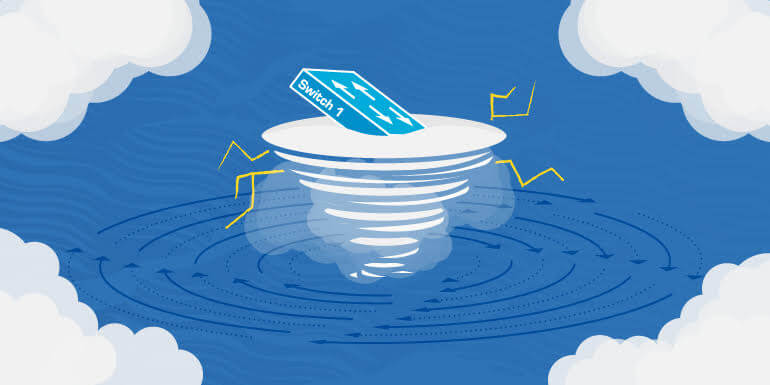
A broadcast storm, also known as a broadcast storm, is a phenomenon that causes significant disruption to a local area network. It occurs when an extreme amount of multicast or broadcast data is continuously replicated across all ports on all switches within the same network or VLAN.
Ethernet network loops, where one switch is connected to another via more than one RJ45 cable or fiber optic cable, are a major cause of broadcast storms. A protocol developed to address this problem is Spanning-Tree; however, if it is disabled or misconfigured, a storm is virtually unavoidable.
On the other hand, this phenomenon can be investigated as a possible denial-of-service (DoS) attack on equipment infected with viruses, or manipulated by attackers to generate "ARP" (Address Resolution Protocol) requests on all machines belonging to the same broadcast domain. The storm directly impacts network performance because it consumes bandwidth as well as CPU resources from the network switches. Therefore, the perception of slowness is clear to users.
Preventing the Broadcast Storm
Preventing broadcast storms begins in the network topology and asset design phase. It's important to define guidelines for network traffic routes and which protocols will be used to ensure high availability of Ethernet networks. Furthermore, efficient monitoring should be implemented, and reliable equipment should be chosen for network operation.
Although local area network planning is a preventative method, it is not 100% effective, as an engineer's error in the logical configuration or physical connection of an asset can lead to the failure of the entire plan. Therefore, major manufacturers – such as Cisco, Huawei, and Datacom – have developed a feature that controls transmission storms.
Storm Control
This feature, called Storm Control, monitors incoming packets on the specified interface and checks if they are broadcast, multicast, or unicast. Based on this, the switch counts the number of packets received and the time interval predefined by the Network Engineer. Although it doesn't solve the broadcast storm at its root, this feature limits the intensity of the phenomenon, allowing the technical team sufficient time to access the equipment, diagnose the problem, and resolve it.
João Calixto – NIS Specialist