Leia esse artigo no Linkedin: https://www.linkedin.com/pulse/nova-superf%25C3%25ADcie-de-ataque-das-empresas-quando-vira-o-inimigo-sanchez-2oulf/?trackingId=OiWd5mbYQBOumr4vIbvxTw%3D%3D
The invisible danger of the corporate race for AI without orchestration, security, or compliance.
In recent months, we've seen a frantic race for Artificial Intelligence in virtually every sector. But few have understood what this really means. The market is diving headfirst into increasingly powerful systems — without realizing that it is opening a new frontier of vulnerabilities.
The problem isn't AI itself. The problem is... Using AI without structure, without governance, and without understanding that each level of sophistication increases risk exponentially.
Level 1.0 — The Illusionism of LLMs
The first stage is the most common: the pure and simple use of language models (the famous corporate chatbots). This is where the classic mistakes of those who think that "using AI" is the same as "plugging a model into an API" originate.
The danger lies in prompt injections, us sleeper behaviors (sleeper cells) and in the leak of proprietary informationA simple malicious command embedded in a text or document can make the template... Ignoring instructions, violating security policies, or exposing confidential data.
And you know what's worse? Most companies He doesn't even realize when it happens.
Level 1.5 — The Age of Agents and Chaos in RAGs
The second stage begins when companies decide to empower their AIs by connecting them to... Vector databases (RAGs) and corporate tools. This is where things really start to go wrong.
These integrations, when poorly done, They open the door to direct attacks on databases.allowing sensitive information to be reconstructed or extracted. Worse still: many of these systems They do not have granular access control....and end up exposing customer data, contracts, and internal records to any inquiry that "seems legitimate."
The AI-connected "tools"—which are supposed to automate—end up being the weakest link in the chain. A poorly supervised agent can... executing improper commands, sending incorrect emails, or even altering operational records.
Without compliance, what they call automation is, in practice, An invitation to disaster.
Level 2.0 — The Challenge of Multi-Agent Systems
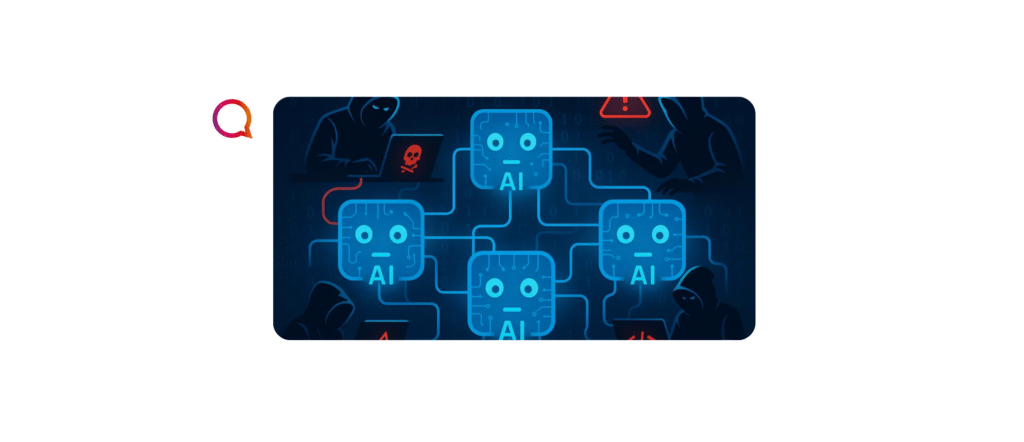
Now we arrive at the most advanced—and most dangerous—point. Systems composed of several autonomous agentsEach one specialized in a function, exchanging information with each other and performing tasks on a network.
The promise is tempting: efficiency, speed, and collaboration between intelligences. But the risk is enormous.
- The agents They may be distributed across different servers, countries, or providers..
- You Attacks can occur in communication between agents., not at visible entrances or exits.
- And if you only monitor the final response, You'll never see what really happened behind the scenes.
In distributed environments (such as MCP or A2A), It's impossible to know what's being done with your confidential data. If there is no audit trail, strong identity, and clear usage policy.
The Illusion of Control
Most companies still think AI is "safe" because it "runs in the cloud." But they forget that... The cloud is shared....and that each poorly configured layer is a vulnerability waiting to be exploited.
Executives are buying "co-pilots," "assistants," and "cognitive platforms" without realizing they are... creating entire ecosystems without a security perimeterIt's the modern version of "Shadow IT," only now with digital brains that... They learn, store, and replicate errors..
The New Paradigm: Zero Trust for Agents
Artificial Intelligence requires a new security mindset. The old "firewall + antivirus" model is dead. Now, control needs to be... cognitive and distributed.
This means:
- Individual identity for each agent (with authentication and digital signature).
- Complete audit of interactions Who spoke to whom, what was exchanged, and why.
- Purpose of use policies for each piece of shared data.
- Orchestration governed, with logs, versioning, and human validation at critical layers.
- Automatic data classificationPublic, internal, confidential, PII.
In summary: Zero Trust applied to Artificial Intelligence.
Conclusion — Intelligence without control is a risk.
With each new level of sophistication, companies gain power—but they also multiply their attack surface. Models that speak, agents that act, systems that decide… and nobody knows exactly what happens. how, where or why.
The era of enterprise AI isn't about "doing things faster." It's about... do it responsibly.
The question every company should be asking itself is not... Do we have AI?but rather:
"Do we have enough governance to avoid being destroyed by it?"
Because the real threat of Artificial Intelligence is not technical. It's organizational. And it begins when haste replaces understanding.
CEO | Leading the AgenticAI Revolution for Enterprise
October 18, 2025