Humanity has been struggling with this for millions of years. linguistic plurality existing on our planet. From Ancient Greece, through the Egyptian Empire, to modern and/or even contemporary society; conversing and communicating with individuals of different nationalities has always represented a challengeIt was not uncommon to seek artifices to "to make oneself understood" and to communicate better, such as through drawings, mime, and inevitably the use of interpreters or translators.
The use and popularization of technology, which promised to bring people closer together in a globalized world, It has transformed (and continues to transform) the field of translations.Artificial Intelligence (always the same) has developed powerful mechanisms for cross-referencing languages quickly and accurately. Some believe that it is no longer necessary to invest time and resources in learning a second or third language; others warn about the danger of blindly trusting content generated by machines.
The fact is that the world of translations and/or text conversions has been transforming! Understand the evolution of this area; The impact of AI on translationsThe advantages and limitations of this technology; and whether certain professions are in danger of becoming extinct. More on this in our blog post below.
Translation Methods with AI
First of all, it's important to understand that translation professionals themselves have been using digital solutions for quite some time. Talking about The use of technology in translations is nothing new.Their methods, therefore, are already quite well established. We highlight:
Automatic Translation
I ask you: What tool do you use to quickly translate text or words online? The vast majority of you will answer that you use... Google Translate (or Google Translator)Yes, this program is a global success (after all, it has the backing of the tech giant Google), but note: it's already over 15 years old!
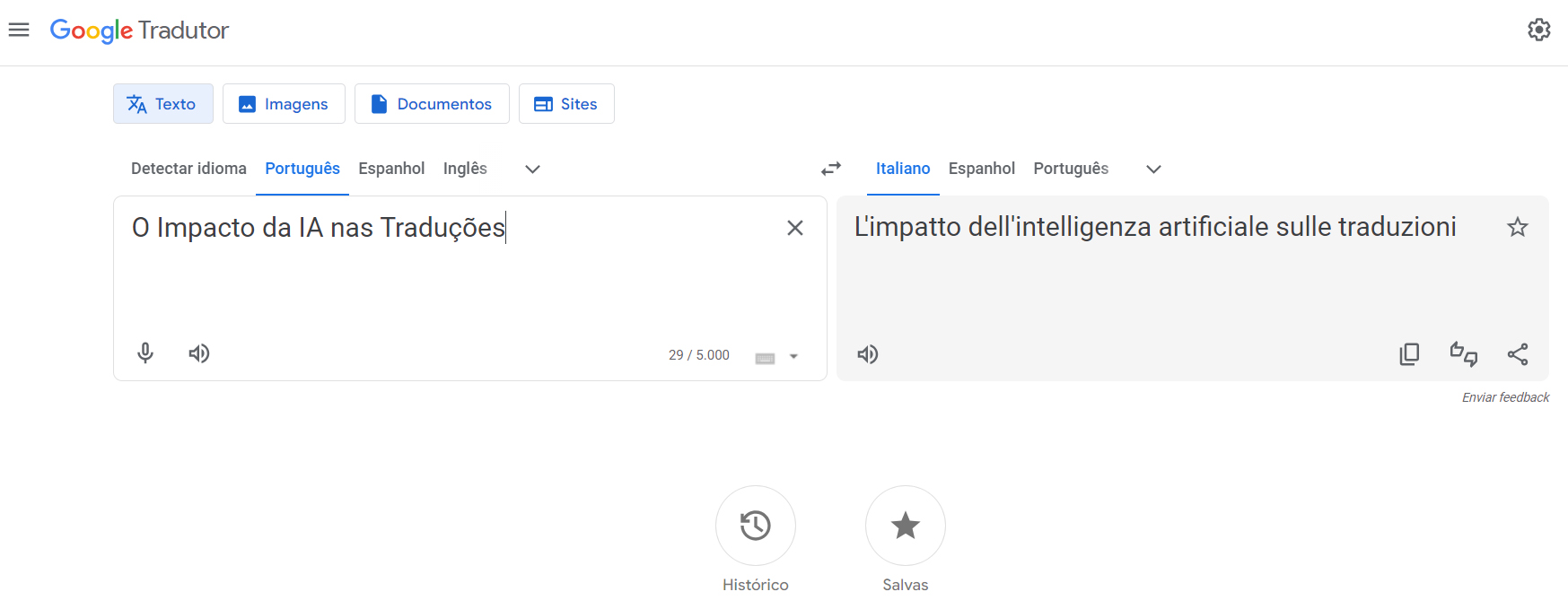
Google Translate is a clear example of automatic translation method – based on linguistic rules, using dictionaries to translate content. The model, although widely used, runs into a crucial problem: The translation is generally literal., encompassing language errors, especially in more sophisticated languages.
Neural Translation
In fact, the Artificial intelligence truly entered the field of translation in 2017 with DeepL. – a methodology-based translation software that accesses and compares translations in approximately 20 languages.
This smart technology works from artificial neurons that take into account the text as a whole and its context.This method also allows for self-development and continuous adaptation based on the high volume of data that is fed into it.
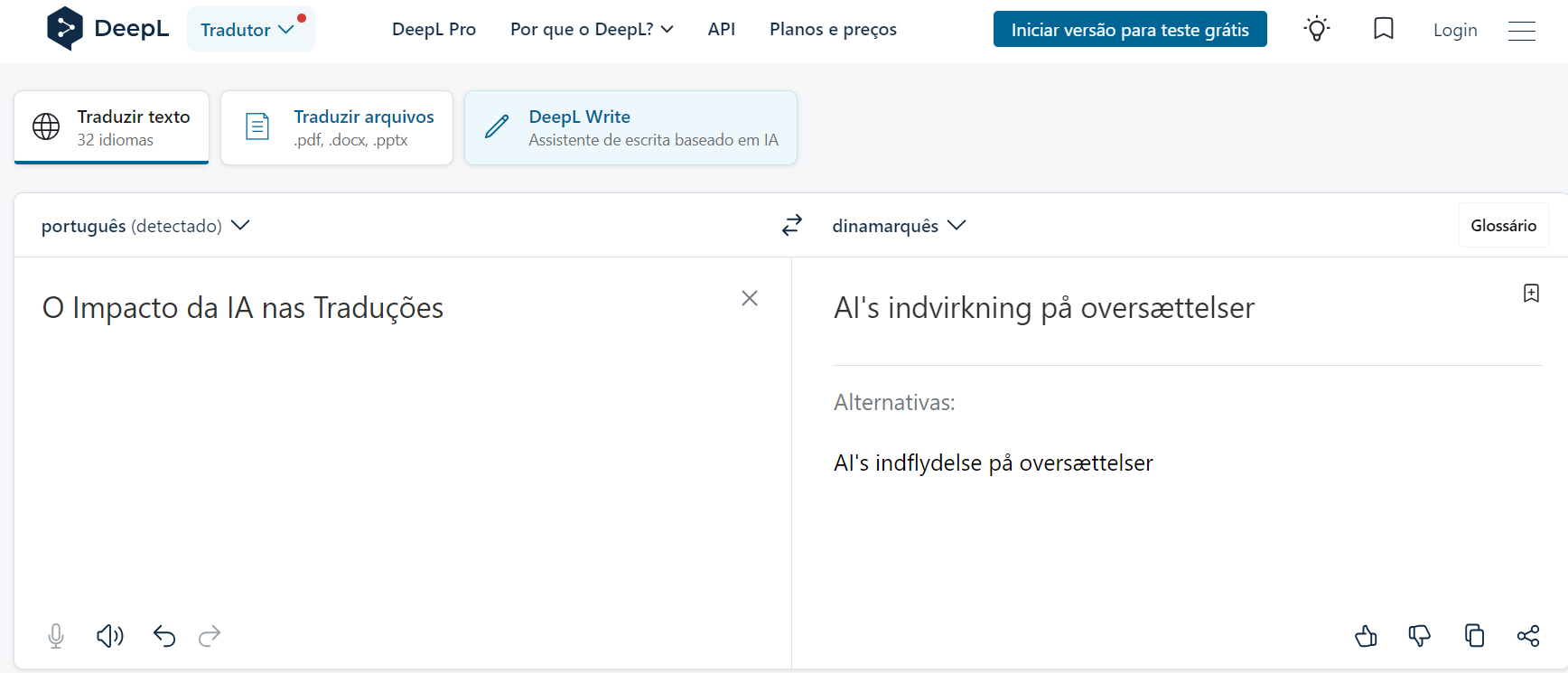
Neural translation made possible obtain much higher quality and smoother text conversions. (when compared to the automatic model).
Translation Software
More popularly known, Google Translate and DeepL are not alone; on the contrary, technological advances (especially AI) have solidified their use. A fertile ground for the emergence of various translation tools.:
Microsoft Translator: Google's competing software that works based on machine learning techniques and is capable of translating more than 60 languages;
Systran: an AI-powered translation program with a database of 130 languages. It uses deep learning methods to optimize the quality of the created texts;
Seamless M4TMeta's translator, which has over 200 languages in its database, uses Artificial Intelligence and machine learning to refine text conversions. It has a unique feature that allows it to translate spoken words directly, without needing to convert them to text first.
ChatGPTOpenAI's generative artificial intelligence isn't exactly a full-fledged translation software, but it is capable of translating words, phrases, or entire texts into a variety of languages, depending on the instructions entered into the platform.
READ ALSO: "ChatGPT-5: What to expect from this upcoming new version?!"
Advantages of using AI in translations
Perhaps the main advantage of Artificial Intelligence in Translations is that The speed at which a high volume of text can be converted. With quality for another language. Yes, AI is fast! And it's becoming increasingly precise and accurate: through machine learning. It can correct itself automatically. optimizing the quality of the generated translations.
Another advantage is that many AI-powered translation software programs...They are able to convert multiple texts into different languages simultaneously. (and not one at a time).
And being pragmatic, AI-based translations They have infinitely lower costs. (even free ones) when compared to traditional translation methods such as translators and interpreters.
Disadvantages of AI in Translations
Since not all that glitters is gold, Artificial Intelligence applied to translations It has its limitations.Although increasingly intelligent, autonomous, and sophisticated, it is not infallible! Especially when compared to traditional methods (such as those used by linguistic and translation professionals).
For example, Technology is not yet able to adapt translation for specific readers or target audiences.A particular word in a medical seminar may have a different meaning in another context/environment.
AI also still ignores local cultural codes and customs. when translating, not taking into account the listener's expectations, style, and intention of the translation.
And no less important: it must be said that AI demonstrates great quality in language conversions between common languages (English, French, Spanish, Portuguese, German, Italian, Arabic, etc.); but when it comes to For rare languages or local dialects (with limited data), the translation quality drops dramatically.Often in these cases, the AI translates "internally" into English before converting to the final language, which It often leads to errors and misunderstandings..
The Impact of AI on Translations
So, will we really no longer need to learn another language? And are translators' days numbered? Will AI render dictionaries obsolete and replace interpreters?
The answer is NO! It's highly unlikely that this will happen! In fact, Free translations and cases that require speed should rely on technology.Even translation professionals themselves frequently use it as a supplementary method.
Highly complex technical, medical, and legal content.where the slightest error or ambiguity could have harmful consequences and/or lead to litigation, should remain in the hands of the translators.
The same should happen, for example, in film dubbing and television programming sectorAlthough some software has recently emerged as an automatic dubbing solution (making voice actors' hair stand on end), the The final result is still an example of the limitations of AI. In this field – translations ignore nuances and intonation of language, practically erasing the quality work done by skilled actors.
And above all: Why learn a new language? Fundamentally, Knowledge is power.Even with so many translation software programs and gadgets, a face-to-face meeting, a negotiation, or even decision-making on an international trip—for all of that, It still makes a difference to know and speak another language.!
The End. The Finale. The End…
READ ALSO: "The Role of Technology in the Education of the Future"
READ ALSO: "Dilemma: Artificial Intelligence versus Copyright"