
MATRIX GO in the MEDIA
Original Article at: Intelligence.Garden: https://intelligence.garden/automacao-robotica-de-processos-avanca-no-brasil-e-se-integra-cada-vez-mais-a-ia/
Robotic process automation (RPA) is gaining traction in Brazilian companies, but its adoption rate still varies significantly across sectors. Industries such as automotive, pharmaceutical, consumer goods, and high-tech manufacturing are at the forefront, driven by technological maturity and the need to integrate previously siloed systems—such as ERP, MES, and SCADA—to accelerate information flow and improve decision-making accuracy.
Implementing RPA (Robotic Process Automation) is a strategic journey to increase efficiency and reduce errors. It involves using software "robots" to automate repetitive, rules-based tasks previously performed by humans. When successful, it typically follows a structured lifecycle.
According to experts interviewed by the Portal Intelligence. GardenIndustry remains the biggest adopter of robotic automation, closely followed by the logistics sector and, more recently, retail and e-commerce. However, sectors such as education, insurance, and legal are still in the early stages of adoption, where there is no structured process automation.
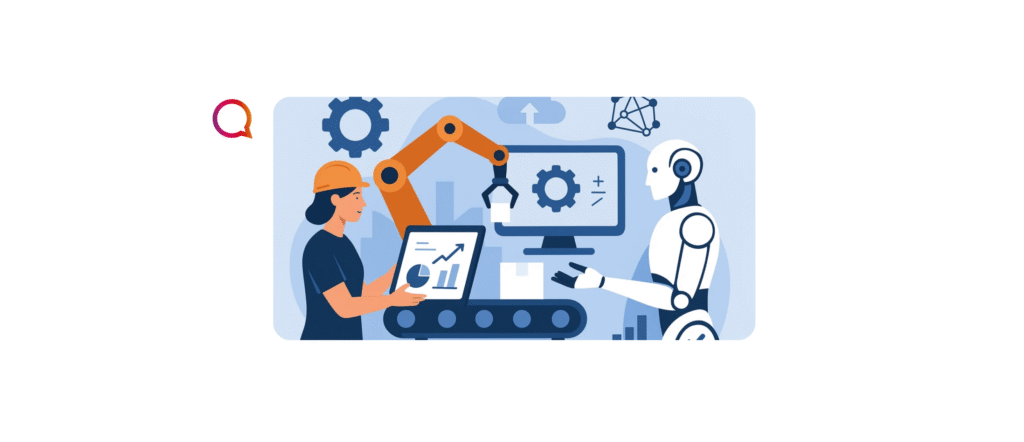
In everyday life, RPA is used to automate repetitive and administrative tasks that support production and service. This includes automatically generating quality reports, transferring data between systems, opening sensor-based preventive maintenance orders, automatically replenishing inventory, and digitally recording inspections. What was once repetitive work—like filling out spreadsheets and entering data—is now being handled by software robots.
"Professionals are then freed up to focus on analysis, process improvements, and decision-making. This often increases both productivity and job satisfaction," explains Michael Lopes, an automation engineer with over 10 years of experience who has developed solutions for companies such as Tesla, GM, and Ford, focusing on energy efficiency, production line automation, and robotics integration.
In service sectors, RPA is also present in customer support, with chatbots, voicebots, and virtual assistants, as well as financial and accounting routines, such as bank reconciliations and issuing invoices.
Wagner Loch, Director of Operations at Under Protection – an information security solutions company – states that automation frees analysts from repetitive tasks, allowing them to focus their time on investigation, threat identification, and continuous improvement of playbooks – standardized guides that describe step-by-step how to perform tasks or respond to specific situations. "The goal is not to reduce staffing, but to increase training and ensure professionals are constantly updated," Loch emphasizes.
Optimize vs. Automate
Before automating, however, experts recommend optimizing. This is because, although often used interchangeably, optimizing and automating are different actions – and understanding this difference is crucial to efficiently improving processes.
Optimize It means improving a process by eliminating waste, correcting errors, and reducing bottlenecks. Analyzing what's being done, identifying unnecessary steps, and reorganizing the workflow to make it more agile and cost-effective. This improvement may or may not involve technology.
Automate, in turn, involves using technology to ensure the process is executed with as little human intervention as possible. This involves tools such as RPA (robotic process automation), artificial intelligence, or integrated systems.
"Optimizing means 'putting things in order'—eliminating unnecessary steps, simplifying, and correcting process flaws. Automating means using technology to make this process run itself. In an industrial environment, it's much more efficient to optimize beforehand. If you automate a process full of bottlenecks, you'll only address errors faster," explains Michael Lopes.
"I understand that optimization is about improving a process by reducing waste, errors, and bottlenecks. Optimization may or may not involve technology and automation. For example, reviewing an unnecessary step in a process represents an optimization, which doesn't necessarily involve RPA adoption. Automation, on the other hand, includes technology to better execute processes," he adds. Nicola Sanchez, CEO of Matrix Go, a company specialized in the development of technology platforms focused on engagement and relationships between companies and customers.
And what happens to teams when RPA enters the scene?
Contrary to popular belief, the trend isn't simply to cut jobs, but to redistribute roles to more strategic activities. In factories, professionals are abandoning manual tasks and focusing on data analysis and process improvement. In services, teams are being reassigned to monitor systems or handle complex cases, while automation absorbs the rote routine.
"Based on our experience with our clients, when they automate a service or sales process, they tend to shift teams to more strategic and/or monitoring tasks, while new hires for operational and mechanical tasks are eliminated. This is the trend I see most often," says Sanchez.
Still, from a more realistic perspective, according to the CEO, although RPA can be used to reallocate people to more strategic roles, the fact is that many companies — especially when prioritizing short-term cost reduction — already choose to replace part of their staff with automation, eliminating operational and repetitive positions.
This is explained by the clear benefits: with accuracy approaching 100% and minimal influence from emotional factors or social biases, RPA ensures consistent and reliable results. Preventive maintenance becomes more efficient, with orders automatically issued before machines fail, reducing unexpected downtime.
Data accuracy also increases, as automation eliminates typing errors and other human errors, making information more reliable. Furthermore, reports and indicators remain constantly updated, enabling faster, more assertive decisions.
“For example, in a critical service with a more nervous customer, AI can identify the customer's emotion and act accordingly with precision and assertiveness (something impossible to guarantee in the same scenario with human service,” adds the CEO of Matrix Go.
Positive results, such as improved customer experience and satisfaction, as well as improved team quality of life, are already noticeable—although more difficult to measure, experts point out.
For Professor Hercules Lima Ramos, from the Tech school of FMU, The gains with RPA are already significant and can be measurable:
"A robot works 24/7, without breaks. It can process a much larger volume of data and faster than a person. Because the robot follows predefined rules, the risk of human error (such as incorrect input) is virtually eliminated. This increases the accuracy and quality of work. There are also compliance benefits: RPA ensures that processes strictly follow rules and regulations, facilitating auditing," he says.
Future scenarios and challenges
The future points to RPA increasingly integrated with artificial intelligence, especially generative intelligence, making software robots more adaptive and capable of interpreting contexts to make decisions.
In Michael Lopes' view, the challenges remain significant. This is because "many factories operate with legacy systems that are difficult to integrate, which complicates the adoption of new solutions."
Add to this the lack of infrastructure and governance, the natural resistance of those who fear losing ground to technology, and the difficulties in correctly mapping processes, a fundamental step for automation to work efficiently.
To Nicola Sanchez, dealing with the human factor, resistance to change and the feeling that “the machine will take my job” are the main bottlenecks that companies will need to face in order to adopt technology.
Another future trend is for RPA to work alongside machine learning, interpreting data from cameras and sensors in real time and automating end-to-end processes—from customer order to delivery.
Cloud solutions and rapid implementations should democratize access for small and medium-sized businesses as well.
Sectors such as telecommunications, pharmaceuticals, healthcare, logistics, automotive, food, beverages, and financial services, as well as industry itself, are expected to feel this impact more intensely in the coming years.
"Looking ahead, RPA will increasingly integrate with artificial intelligence and predictive analytics, enabling smarter actions, such as automatically adjusting a production plan based on demand or machine performance," says Michael Lopes.
For Professor Hercules Lima, the adoption of RPA also faces barriers such as the high initial cost and the complexity of integration with legacy systems – which represent significant barriers to RPA implementation.
"This combination of RPA with other more advanced technologies is likely what will define the future of work. Where we see a robot performing a task today, we'll soon see an entire system learning and adapting," says the professor.
On another note, Wagner Loch, from Under Protection, believes that the biggest challenges of automation are threefold: data quality, systems integration, and change management.
"Automation is only effective if the input data is reliable and standardized; otherwise, there's a risk of automating errors. In Brazil, we still find environments with multiple legacy (old) platforms that hinder native integration between tools, requiring customization and additional investment. Furthermore, there's a cultural issue: teams need to trust and understand automated workflows, avoiding resistance to use and ensuring qualified supervision," he reflects.