Read this article on Linkedin: https://www.linkedin.com/pulse/linguagem-natural-o-c%25C3%25A9rebro-que-pensa-sente-e-simula-entre-sanchez-yoief/?trackingId=J75%2FwctQQA%2BO4VK7oXndiw%3D%3D
Understanding language is much more than predicting words — it's about interpreting the inner world of emotions and the symbolic context of the mind.
Introduction
Since I started studying neuroscience and linguisticsOne question has been bothering me:
"How does the human brain transform electrical impulses into language and meaning?"
Years later, when observing the evolution of LLMs and the Agentic AII realize that the answer still lies on a fine line between mathematics and emotion.
The term "natural languageThe term "natural language" is often used superficially in the tech world—as if it were simply the ability to "understand sentences in Portuguese or English." But in reality, what we call natural language is the... living expression of consciousness, shaped by biological, social, and emotional contexts.
What is natural language?
THE natural language It is the way the human brain organizes thoughts, emotions, and memories into symbols that can be... shared with other brainsIt's not just a system of words, but a cognitive process that connects emotion, perception, and reasoning..
Every sentence we utter stems from a complex sequence:
- Sensory perception (input) – the brain registers the environment through the senses;
- Emotional coding – the limbic system assigns affective value to stimuli (“good”, “bad”, “threatening”, “pleasant”);
- Cognitive processing The prefrontal cortex translates this emotion into intention and thought.
- Linguistic expression Broca's and Wernicke's areas transform this thought into coherent words;
- Social feedback The brain interprets the other person's reaction and adjusts communication accordingly.
Language, therefore, It is a bridge between emotion and reason. — between what we feel and what we are able to articulate.
Brain, emotion and elaborate feeling
From a neuroscientific point of view, there is a fundamental difference between emotion and elaborate feeling:
- Emotion is a primary neurochemical stateIt's fast, automatic, and unconscious. It prepares the body to react—to fight, flee, protect itself, approach.
- Elaborated feeling, on the other hand, is the Cognitive interpretation of emotionThat's when the brain assigns meaning Regarding emotion: "I feel anger because I was wronged," "I feel joy because I achieved something."
This translation is mediated by regions such as the ventromedial prefrontal cortex and the orbitofrontal cortex, which connect emotion and language.
Emotion is the electrical signal. Feeling is the narrative the brain creates to justify that signal.
Without language, there is no elaborate feeling—only pure emotion. Therefore, Language is the instrument that transforms impulses into consciousness.
And where do the machines come in?
You language models (LLMs) attempt to reproduce this process, but without awareness or emotion. They They map statistical correlations between words., without experiencing what they represent.
In technical terms, an LLM does not understand the content, she estimates the probability of a semantic sequenceIn the brain, language is a product of emotion and context; in AI, it is a product of... tokenization and neural weights.
That's what I usually call "simulation of meaning" The model replicates language behavior without feeling what it is communicating.
While the human brain says:
"I'm scared because there's a risk."
The AI simply recognizes that the sequence "I'm scared" tends to be followed by "because something happened." predicts human speech, but does not experience it.
The trap of anthropomorphism
A large part of the misconceptions about AI stem from cognitive anthropomorphism — the human tendency to assign mind and emotion to any system that communicates smoothly.
But linguistic fluency in an LLM does not prove understanding, only statistical efficiencyWhen ChatGPT or a corporate agent responds with empathy, it He feels no compassion. - he replicates the linguistic pattern of empathy..
This is both fascinating and dangerous: fascinating because it brings human-machine dialogue closer; dangerous because It can mislead people and companies about the true level of awareness of these tools.
The fundamental difference
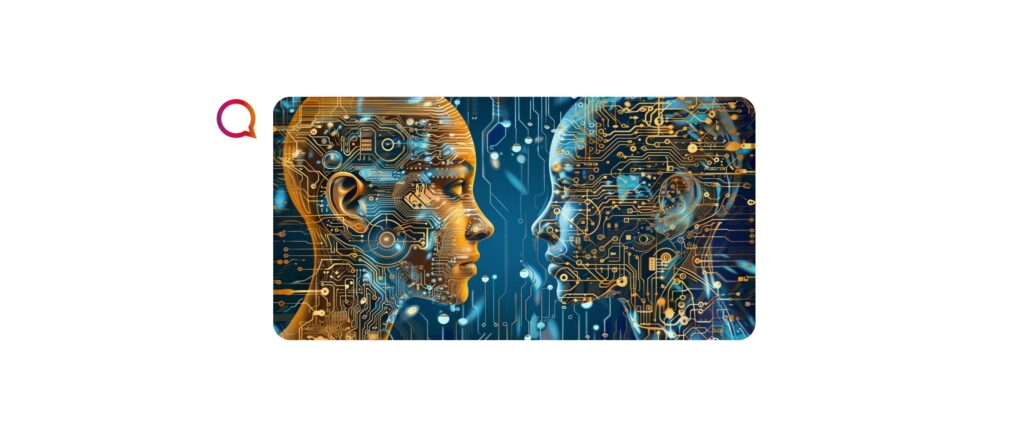
THE human brain It is a biochemical system that... self-actualizes emotionally; one LLM It is a mathematical system that... self-adjusts statistically.
- The brain creates meaning through experience.
- AI creates coherence through probability.
Both produce language, but only humans do. feels What it communicates. And it is precisely this gap — between sensing and simulating — that defines the limits of current artificial intelligence.
Matrix Go and the concept of Agency Intelligence
In the Matrix GoWe treat this difference as the central axis of Agentic AI: agents that simulate reasoning, but They operate under human supervision.where the Meaning and emotion are validated by the operator..
While the mathematical model generates linguistic coherence, the human adds what the machine lacks. intention, purpose, and emotional ethics.
It's the point where Neuroscience, linguistics, and AI engineering meet.Natural language is no longer just an interface; it's becoming... a field of cognitive cooperation between man and machine.
Conclusion
Natural language is the mirror of the human mind: it translates the invisible—emotions, thoughts, memories—into something that can be shared. Therefore, no AI will be complete until it understands what it is. to feel.
True intelligence lies not in speaking well, but in understanding the emotional meaning of what is said.
In the future, the most advanced systems will not only be those that process databut those who recognize human contexts — and they collaborate with our language, they don't just repeat it.
#MatrixGO #Neuroscience #LinguagemNatural #IACognitiva #MorpheusAI #NeuroLinguistics #IAAgentica #CérebroHumano #TransformaçãoDigital #AIWithPurpose #CocognitionEmocional
CEO | Leading the AgenticAI Revolution for Enterprise
October 14, 2025