
Read this article on Linkedin: https://www.linkedin.com/pulse/ia-machine-learning-e-aprendizado-profundo-entendendo-nicola-sanchez-2bmkf/?trackingId=RQNOKv32Nii2zsC52n1ZDA%3D%3D
Behind the brilliance of generative AI lies a learning architecture that redefines what it means to “teach a machine.”
Artificial intelligence (AI) is everywhere—from sentence-completion apps to self-driving cars. But despite the topic's popularity, many still confuse AI, machine learning and deep learning as synonyms. In fact, they are levels of technological evolution, connected as layers of the same digital brain.
Artificial Intelligence — the umbrella of the digital mind
THE Artificial Intelligence (AI) is the broadest concept: the field of science that seeks to create systems capable of reason, learn and act like humansIt ranges from simple rule-based algorithms—such as a system that follows the “if X, then Y” principle—to complex, self-adjusting neural networks.
We can think of AI as the philosophical and functional vision of a world where machines not only carry out orders, but understand contexts and make decisions.
Classic examples:
- Virtual assistants (such as Alexa, Google Assistant, or enterprise bots);
- Recommendation systems (Netflix, Spotify, e-commerce);
- Autonomous robotics, computer vision and natural language processing.
AI is the why. Machine Learning and Deep Learning are the as.
Machine Learning — learning from experience
Machine Learning (ML) is a subarea of AI focused on teaching machines to learning from data — without having to manually program each rule. Instead of saying “do this,” we show the system examples and it discover patterns on your own.
Imagine training a model with thousands of emails marked as "spam" and "not spam." Over time, it learns the differences and begins classifying new messages on its own.
This is the principle of ML: statistically-based learning, feedback, and prediction.
Typical applications:
- Credit systems and risk analysis;
- Fraud detection;
- Demand or churn forecasts;
- Medical diagnosis by historical patterns.
Machine learning is the engine that powers most applied AI today.
Deep Learning — the synthetic brain
Deep Learning is a machine learning subset, inspired by the structure of the human brain. It uses artificial neural networks — systems composed of layers of “digital neurons” that process large volumes of data, learning increasingly abstract representations.
If machine learning learns from tables, deep learning learns with the real world: images, sounds, texts, emotions. This is what enables a model to recognize faces, translate languages, generate images, or write texts with human fluency.
The secret is in the multiple layers of processing (hence the name) deep) that refine learning step by step, as if the model created its own perception of the environment.
Examples of use:
- Facial and voice recognition;
- Autonomous cars;
- Generative AI (like ChatGPT, Midjourney, Gemini, Claude etc.);
- Automatic translation and smart subtitles.
The arrival of generative AI — the leap from imitation to creation
THE Generative AI is the pinnacle of deep learning. It doesn't just analyze data—it creates new original content: texts, images, videos, codes and even music.
These models are trained with huge volumes of data and learn complex patterns of language and context, simulating human creativity.
Combining deep learning, probabilistic modeling and human feedback, generative AI is the embodiment of the AI dream:
machines capable of thinking, creating and collaborating with us.
Convergence: When Machines Learn with Purpose
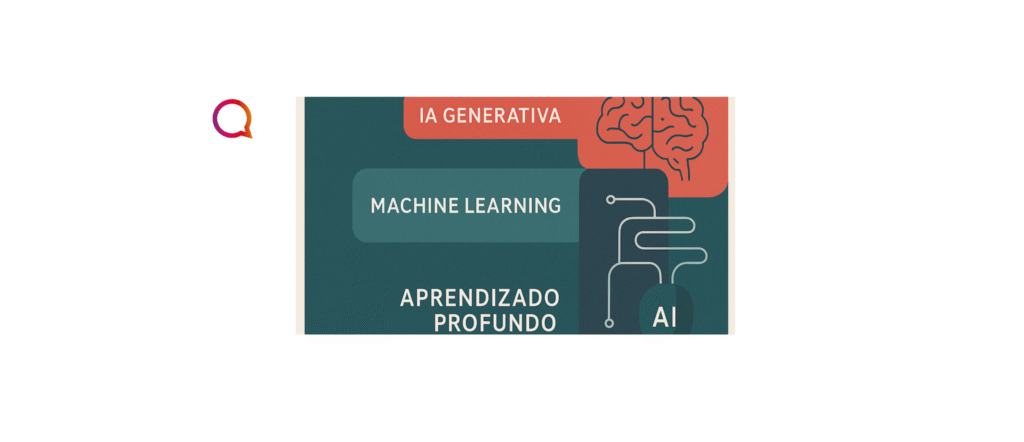
Each layer of AI has a role:
- IA defines the purpose (to imitate human intelligence);
- Machine Learning teaches patterns;
- Deep Learning creates complex representations;
- Generative AI produces something new.
The result is an ecosystem where machines not only follow rules, but learn and evolve — as long as they do so ethically, transparently and responsibly.
Conclusion
Artificial intelligence isn't just technology—it's an extension of human curiosity itselfJust as we learn from the world, we are teaching machines to learn from us. And as they become more sophisticated, the real challenge will not be making them think… but make them think with purpose.
CEO | Leading the AgenticAI Revolution for Enterprise
October 5, 2025