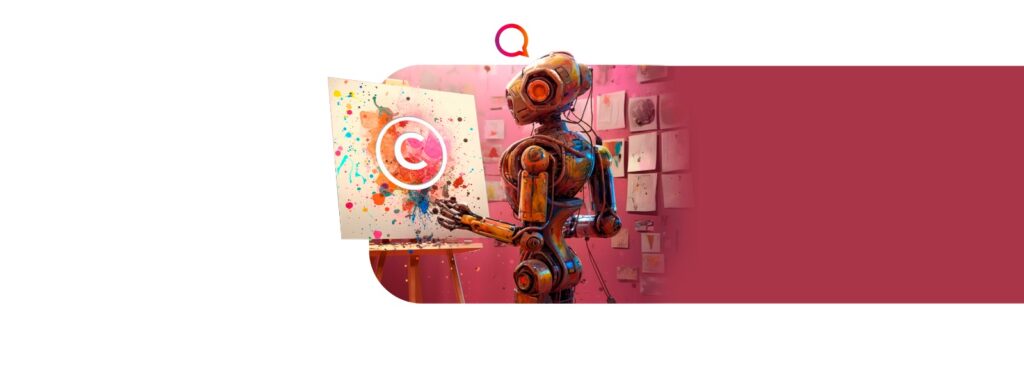
Imagine the scene: you, a Marketing Analyst at a company, decide to take advantage of recent technological advances to create a new logo and visual identity for your organization. To do so, you turn to Microsoft Copilot (generative AI technology), and after a series of attempts, you're satisfied with the generated art. Okay...now what? How do you register and ensure that the machine-generated art is exclusively yours and cannot be generated or reproduced by any competitor? Here's the key question: What is the legal viability of applying copyright to materials produced by AI?? A real dilemma: Artificial Intelligence versus Copyright.
Another recent example of the uproar was researcher Stephen Thaler's emblematic attempt to register a work of art (A Recent Entrance to Paradise) produced with the help of AI. The request was denied by the agency responsible for copyright USA, which led to a lawsuit by the researcher and a new defeat, in which the judge guaranteed that current legislation only “protects works of human creation”.
The issue was also raised in the recent strike of Hollywood screenwriters that are seen threatened by the increasing use of AI in the development of texts. According to this understanding, studios, therefore, could not replace screenwriters with Artificial Intelligence.
An even more palpable example of the problem involves universities and schools around the world: monographs and school works developed by AI still raise ethical and functional issues about learning and quality of teaching.
Acknowledgment of Authorship
THE fundamental question in this discussion about copyright is to recognize or not the authorship of a work, be it literary, artistic or scientific, developed by a machine.
And the problem is that given the recent innovation, there is still no legal unanimity on this point, among experts, and especially among nations. For example, in England, works produced by robots are already protected by copyright – the law attributing authorship “to the person who makes the necessary arrangements for the creation of the work”, and not to machines.
Us USA, legislation still only protects works of human creation. But the U.S. Copyright Office (US Copyright Office) begins to recognize the possibility of registering works created by AI with “sufficient human intervention”.
What about Brazil?
Analyzing purely from a legislative point of view, Brazilian legislation does not yet have a regulatory framework that allows the granting of authorship of a work to AI. According to Law No. 9,610/1988, it is guaranteed that copyright protection for intellectual works “originating from the creations of the spirit” – in other words, artificial intelligence naturally lacking spirit is not recognized.
However, it should be noted that current legislation dates back to 1988, a time when computers were barely mentioned, much less Artificial Intelligence. The context today is different, and discussions on the topic have intensified. Experts and legal experts believe that it is a matter of time for a regulatory update on the topic.
Shared Authorship?
An interesting way out that has been gaining traction in copyright discussions would be attribute a kind of shared authorship between: the creator of artificial intelligence (responsible company), the one who operates it (user) and the who enters the information needed to generate content (programmer).
Thesesolution is seen as momentary or transitory, until countries reach a general consensus on the issue, seen from a global perspective.
Brazil – Legislation
In Brazil, a Bill presented by Deputy Aureo Ribeiro (PL1473/23) intends to force companies that operate AI systems provide tools that allow authors to restrict the use of their materials by algorithms.
This solution was partly criticized by precisely limit AI advances and innovations and mainly, have a very limited technical feasibility, after all, it does not explain how such controls would be established, given the opaque and non-transparent nature of these tools.
It's expected that new projects and discussions on the topic will intensify as technology advances and specific cases are brought to justice. It's only a matter of time!
Accountability
Another widely discussed factor regarding Copyright is the Accountability for AI-generated content. For example: biased textual content or content containing false and biased information; and/or graphic production of criminal, harmful and defamatory images; also: copied/plagiarized musical content – Who should we turn to in these cases?
Who generated the content (user)? Or who designed and enabled its creation (programmers and companies)?
THE shared accountability is again a faster and more appropriate way out. What cannot be allowed to happen is for large technology companies to “wash their hands” of the content generated by their platforms; on the contrary, they especially have the know-how and technical tools to promote security and control mechanisms, and for that very reason, they need to be held accountable.
It doesn't stop there
The fact is that this whole discussion about copyright and AI is still colossally behind schedule! That's because technology and its advances come out ahead, and the time for consolidation, regularization, legislation, and enforcement is infinitely longer. It's as if in a race, AI travels by rocket, while laws follow in a small, engineless boat.
And since progress never stops, it is quite possible that all the probabilities presented here will become obsolete tomorrow, next week, or next year…
Note, for example, that in Saudi Arabia, a robot received the title of citizen. Developed by Hanston Robotics, the robot Sophia has an Artificial Intelligence system capable of learning to express emotions like humans.

And if legally she is considered a citizen, legally it is possible for her may be recognized as the author of the works it generates, and more than that, be held legally responsibleYes, a robot! In fact, there is still much to debate and delve into on this issue.
READ ALSO: “The Importance of Transparency in AI Implementation”
READ ALSO: “Help! AI is going to take my job?!”