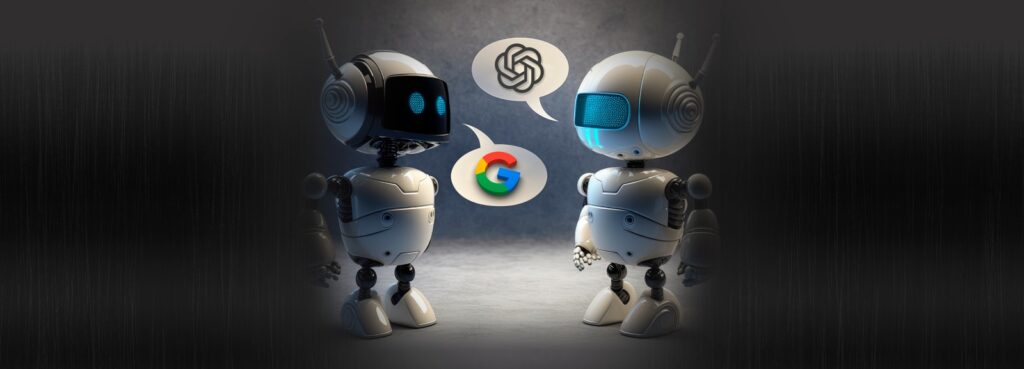
Google Bard and ChatGPT They are set to engage in a fierce battle in the coming months for leadership in the artificial intelligence market, and for good reason. Although OpenAI's solution was the pioneer, its rival continues to evolve.
While ChatGPT has translation capabilities, but Google Bard surpasses it by offering extremely accurate translations in a variety of languages.Whether for documents, web pages, or real-time conversations, Google Bard is the most reliable option for accurate translation.
The web giant's generative AI started its life with some problems, such as an error right at the beginning and a lack of relevant features. But it managed to recover by presenting a set of notable improvements at Google I/O 2023.
Bard X ChatGPT
1. Discover the source of the information.
One of the biggest problems with chatbots is knowing whether the information is reliable or false. ChatGPT doesn't show where it gets its information from, so you just have to trust the bot. Google Bard, on the other hand, allows you to find out where each part of your response came from. Lists, statistical data, or blocks of code can be marked and underlined to highlight the source website.
2. Real-time internet search
Bard connects to Google to search the internet in real time. The free ChatGPT does not do this and has a database limited to September 2021., therefore it cannot present recent news or information from 2022 or 2023.There is a version of ChatGPT under development, still closed to users, that will do this soon. But for now, Only Bard has this advantage..
3. Create images from text
The current Bard version does not support creating images from descriptive text.However, this should change soon. There is a version nearing release that will integrate with Adobe Firefly to make this a reality. ChatGPT has nothing similar, not even in development. Rival Bing, which uses the same GPT-4 technology, has its own tool called Image Creator that does this.
4. Search by voice command
Bard uses a microphone icon to conduct searches using voice commands. The chatbot converts audio to text and performs the requested actions, which is great for those accessing via mobile phone or PC with a built-in microphone/headset. As for... ChatGPT only accepts text input from the keyboard. There are some user-created adaptations, such as Petey for Apple Watch, which offers a text-to-speech feature, but there is no official support for the reverse.
5. Export generated text
With a full suite of Workspace applications, the Bard has a significant advantage when it comes to integration.. Google's chatbot has a button that allows you to export the created text to Gmail and Docs later. More will be included. As for... ChatGPT doesn't have any built-in software or an export button. Anyone wanting to extract the content needs to use the good old Ctrl+C and Ctrl+V or take a screenshot.
6. Group page links
Google Bard can count how many links are on a web page and summarize the content of each one. This feature helps to provide more context for well-structured articles, since the user doesn't need to click to find out what it's about.ChatGPT is unable to access or interact with other websites yet: any attempt to insert links results in an error message. To summarize something, you need to request the task, copy the desired text, and paste it into the text box.
7. Respond with multiple styles
Bard can deliver short, medium, or longer answers, depending on your needs.The chatbot will also allow you to define your desired writing style, such as a more formal tone for work or a more relaxed writing style. Bing Chat already has a similar, and even more complete, mechanism, but the original ChatGPT has nothing quite like it.OpenAI has done some testing using a filtering system, but to date it hasn't released it widely to everyone. If you want a more complete or funnier answer, you need to ask the robot in the reply.
8. Advanced Programming
Both ChatGPT and Bard can create programming code, but there are critical differences here. The solution of Google has its own advanced mechanism, called Duet AI, to do this quite competently. The system was trained on an algorithm capable of correcting incorrect lines, optimizing source code, and even guiding the developer in C++, Python, Java, TypeScript, JavaScript, and several others. It is, therefore, a more advanced solution for those who produce software or games. ChatGPT knows how to program only because it learned it at some point during training. There was no specific concern on the part of the developers to do this, which explains the errors when creating more complex software or applications.
9. Suggest research and topics
THE Bard has an interesting feature for contextualizing questions.This means that he will never just give a dry, canned answer, as there will be links to websites and related content ideas. ChatGPT does not yet indicate its sources of information, nor does it have a suggestion system.If you ask for three beach destinations to travel to in South America, it will create a list with names. Bard will explain each one, provide images and videos, and suggest products to bring, such as sunscreen, swimwear, and a parasol.
10. Search using images
As previously mentioned, ChatGPT only supports text input. There's no point in trying to send him an image to describe or summarize, because there's no audiovisual input prompt. Bard allows users to take a photo with their mobile phone or upload it from their computer. You can request a caption for a social media image, a joke, or links to websites where you can buy that product.
It seems that the dispute between the Google Bard and OpenAI ChatGPT are still a long way from being finished. What will the two AIs present in the future? That's what everyone is wondering, especially with the immense evolution of the last six months.
Why didn't Google bring its ChatGPT rival to Brazil?
Although Google is a global company that offers many of its products and services in different countries, the availability of a particular product may depend on several factors, including local demand, regulatory restrictions, and market considerations. It's important to remember that GPT-3, the model in which... ChatGPT is based on, and was developed by, OpenAI, a company separate from Google.
In the specific case of a ChatGPT rival developed by Google, I don't have up-to-date information about their specific projects and plans to bring a similar language model to the Brazilian market. However, it's important to highlight that the development and implementation of an artificial intelligence system requires extensive research, testing, resources, and infrastructure.
Therefore, it may be that the Google is evaluating the feasibility and potential of launching a ChatGPT rival in Brazil, considering aspects such as Brazilian market demand, adapting the model to the Portuguese language, and other relevant factors.It is always possible that in the future Google may decide to launch a similar or equivalent product in Brazil or other countries, according to its business strategy and specific market considerations.